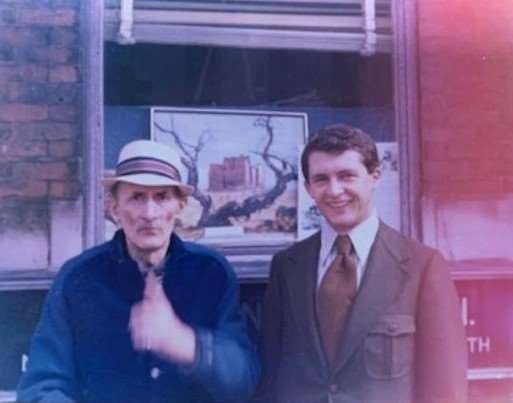
Vojislav Bumbaširević, Jean Lambert, and Osnabrück as a Place of Remembrance
In every research there are moments when history ceases to be a mere collection of dates and documents, and a human being appears — with his voice, fate, fear, faith, hope, and dignity. Such a moment was my encounter with the book April 1941, the testimony of Vojislav V. Bumbaširević, a royal Yugoslav officer, intellectual, artist, and prisoner of war of Oflag VI C Osnabrück, preserved for future generations by his nephew Jean Lambert.
In every research there are moments when history ceases to be a mere collection of dates, documents, and archival references. Then a human being appears before the researcher — with his voice, fate, fear, faith, hope, and dignity. Such a moment for me was the encounter with the book April 1941, the testimony of Vojislav V. Bumbaširević, a Yugoslav royal officer, intellectual, artist, and prisoner of war, whose life's path led from Kruševac, Belgrade, and wartime Yugoslavia to distant Chicago. I received the book from his nephew, Jean Lambert, who lives in Canada today. For me, that fact was never a mere bibliographic detail. From the very beginning it carried a deeply personal meaning. Jean Lambert was not an accidental keeper of a manuscript, but a man who knew his uncle well, who had a close and intimate relationship with him, and who carried his story within himself for years. His own life was likewise marked by migrations, cities, and continents: as a young man he lived in Belgrade, later left Belgrade for Chicago, and finally life took him to Canada. That is precisely why his testimony meant more to me than second-hand family memory: in it, Belgrade, Chicago, Canada, and Osnabrück came together — the city where his uncle's fate became part of a wider history of Yugoslav officers in German captivity.
Vojislav V. Bumbaširević was born in Kruševac in 1910 and died in Chicago in 1974. His book April 1941 was not written as a classical historical study, but as the personal testimony of a man who took part in historical events. It is the story of a man who, on April 6, 1941 — at the moment when bombs were falling on Belgrade — was mobilized as a reserve officer of the Royal Guard. That day, which changed the course of life for millions, also marked the beginning of his long wartime journey: from the collapse of the Kingdom of Yugoslavia, through captivity in Germany, to the years spent in the camp Oflag VI C in Osnabrück. The book was created from audio recordings Bumbaširević made in the early 1970s. Those recordings were not a cold recital of the past, but an attempt to preserve, after so many decades, what had been lived through, seen, and remembered. Jean Lambert took those tapes, transcribed, arranged, translated, supplemented, researched, and edited them. He became, in the best sense of the word, a bridge between his uncle's voice and future readers. Without his work, patience, and family devotion, many of Vojislav Bumbaširević's memories would probably have remained scattered across cassettes, notes, and family keepsakes.
For my research, the parts of the book relating to Osnabrück and the camp Oflag VI C Osnabrück-Eversheide are of special importance. That camp was not merely one of many places in the German captivity system. It was one of the central places of suffering, life, and memory of the Yugoslav royal officers in the Second World War. Officers of different origins, political convictions, faiths, and life paths were imprisoned there. Among them were many Serbs, but also a significant number of officers of Jewish descent. It is precisely this fact that gives the camp a special place in the history of Serbian, Yugoslav, Jewish, and German remembrance. Oflag VI C in Osnabrück was a place of forced confinement, but also a place where the imprisoned officers tried to preserve their human dignity. Under conditions of restricted freedom, uncertainty, deprivation, and constant separation from their families, they organized cultural, religious, educational, and artistic life. They read, studied, debated, wrote, painted, staged theater performances, concerts, and lectures. The camp had libraries, study groups, discussions, and inner communities. That life was not idyllic — there were political divisions, ideological tensions, and personal dramas. But precisely therein lies the historical truth of this place: the camp was not an abstract mass of prisoners, but a living community of people, with all their virtues, weaknesses, divisions, and hopes.
In one of his letters from captivity, Bumbaširević writes from Osnabrück to his sister. From that letter radiates the wish to send comfort to the family, to show that he is still alive, that he thinks of his loved ones, and that he is trying to keep his composure. He mentions that he reads, that he paints, and that performances and even film screenings are organized in the camp. These details are precious because they show what is so often lost in grand historical surveys: in captivity, people did not live merely as numbers, but as individuals striving to defend their inner freedom. Bumbaširević's story also carries within it the trace of the Belgrade that was lost in 1941. In the opening parts of the book one senses a world on the eve of catastrophe: the city, the tram, the mobilization, the Royal Guard, intellectual life, painting, books, family, and home. That world was destroyed in a matter of days. For Bumbaširević, April 1941 was not merely a military defeat, but the breaking of a life. He never again saw his country as he had left it, nor his home, his paintings, his loved ones, and his former life. That is precisely why April 1941 is not only a military testimony, but also the story of the lost world of a whole generation of Yugoslav officers.
The most tragic event in the history of Oflag VI C was the Allied air raid on Osnabrück on December 6, 1944. The camp grounds were hit, and a great number of Yugoslav prisoners lost their lives. For the survivors, that attack remained a deep wound — they were prisoners of war, men who took no part in combat operations and who stood behind the wire. Later interpretations speak of a tragic error, a misidentification of the area, or a failure of information. Regardless of the military explanations, for the people in the camp the consequence was horrific: the death of comrades, the destruction of barracks, fear, injuries, and even harsher conditions of life. After that raid, the camp was never the same. Destroyed barracks and the lack of light, water, and basic necessities made the prisoners' daily life even worse. An already difficult captivity turned into an even more uncertain struggle for survival. In those final months of the war one sees the whole tragedy of men who had survived the collapse of their state, years of captivity, and the bombing — and still did not know whether they would live to see freedom.
The end of the war did not come as a simple liberation. In March 1945, as the front drew near, part of the prisoners were forced into evacuation and long marches. Those marches — among which the book mentions the "generals' march" — reveal the final phase of the disintegration of the German war machine, but also the last drama of the Yugoslav officers in captivity. Elderly officers, sick, exhausted, and starving men, moved through rain, cold, and the chaos of the war's final days. For many, it was the last test of strength. Liberation came in an atmosphere of total collapse. German units were retreating, the guards were losing control, Allied forces were advancing, and the prisoners found themselves between fear and hope. For Bumbaširević and the other survivors, the encounter with British soldiers meant the end of a long and tormenting period. But freedom did not mean the end of all questions. Many Yugoslav officers did not know what awaited them in the new, postwar Yugoslavia, where the monarchy had disappeared and a new communist order had taken power. Thus their fate continued even after the war — often in emigration, in silence, or in family memory. After the war, Bumbaširević continued his life far from the country of his origin. He ended up in Chicago, like so many others whose biographies were scattered by war, ideologies, and shifting borders. Therein lies the particular tragedy of his life story: a man who as an officer had sworn an oath to king and fatherland, who survived the April collapse, German captivity, and Osnabrück, spent the last period of his life as an emigrant in America. Yet it was precisely there, in Chicago, that his testimony was born. He spoke not only for himself, but for a generation that remained on the margins of historical memory for far too long.
The role of Jean Lambert in preserving that testimony is, for me, of exceptional importance. He is not merely the editor of a book. He is someone who gave his uncle back his voice. His work on the audio recordings — transcribing, translating, verifying, and editing — was an act of family fidelity, but also of historical responsibility. From our contact I sensed that the bond between uncle and nephew was deep and sincere. Jean Lambert did not speak of Bumbaširević as a distant relative, but as a man who had profoundly marked his life and memory. When he entrusted the book to me, it was not merely the gift of a copy. It was an act of trust. Into my hands came a testimony that had traveled a long road: from Belgrade and wartime Yugoslavia, through Osnabrück and Chicago, to Canada — and then back again to research that returns to Osnabrück as a place of memory. For me, that circle carried a deep symbolism. History, if it is truly kept, does not remain locked in one place. It travels with people, families, letters, books, and memories.
Osnabrück today is a city where the traces of that camp are still present. Barrack 35, the grounds of the former camp, the cemeteries, and the memorial sites bear witness to the people who spent years of their lives there or lost their lives there. At the Eversburg cemetery rest many who never returned to their families. Some were Serbs, some Jews, some members of other peoples of former Yugoslavia. All of them, however, are part of one shared history of suffering and remembrance. That is why the story of Vojislav Bumbaširević is not merely one biography. It is a window into the fate of an entire generation. Through it we see Belgrade on the eve of the bombing, the Yugoslav army in collapse, German captivity, Osnabrück as a place of life behind the wire, the tragedy of the bombing of December 6, 1944, the final marches at the war's end, and the postwar emigration. We also see how a nephew, Jean Lambert, preserves the memory of his uncle decades later and turns it into a book that helps us today to better understand the past. In my research this book holds a special place because it connects archival history with family memory. It confirms that the truth about the camp Oflag VI C cannot be understood through numbers, maps, and military reports alone. We also need the voices of the people who were there. We need letters, memories, family stories, and the testimonies of descendants. Without them, history would be more precise in numbers, but poorer in humanity.
Thanks to Jean Lambert, the voice of Vojislav V. Bumbaširević has not vanished. Thanks to his devotion, one personal story has become part of the wider memory of the Yugoslav officers in Osnabrück. And thanks to such testimonies, we can today restore names, faces, and destinies to those who remained hidden for too long behind the general notions of war, captivity, and emigration. I therefore write this text not only as a historical note, but as a sign of gratitude. Gratitude to Vojislav Bumbaširević for leaving his testimony. Gratitude to Jean Lambert for preserving, editing, and sharing it. And gratitude to all descendants who are willing to open family archives, letters, and keepsakes, so that the stories of their ancestors may become part of our shared memory. For Osnabrück is not only a place of suffering. It is also a place of encounter. A place where history and memory, Serbia and Germany, Jewish and Serbian destinies, descendants and researchers, past and future can meet today. In that encounter lies the meaning of our work: that forgotten stories may regain their voice, and that the people who passed through the camp Oflag VI C may receive their dignified place in history. Dr. Željko Dragić, 30 May 2026
📄 Original essay in Serbian (PDF)
#Oflag VI C #April 1941 #testimonies