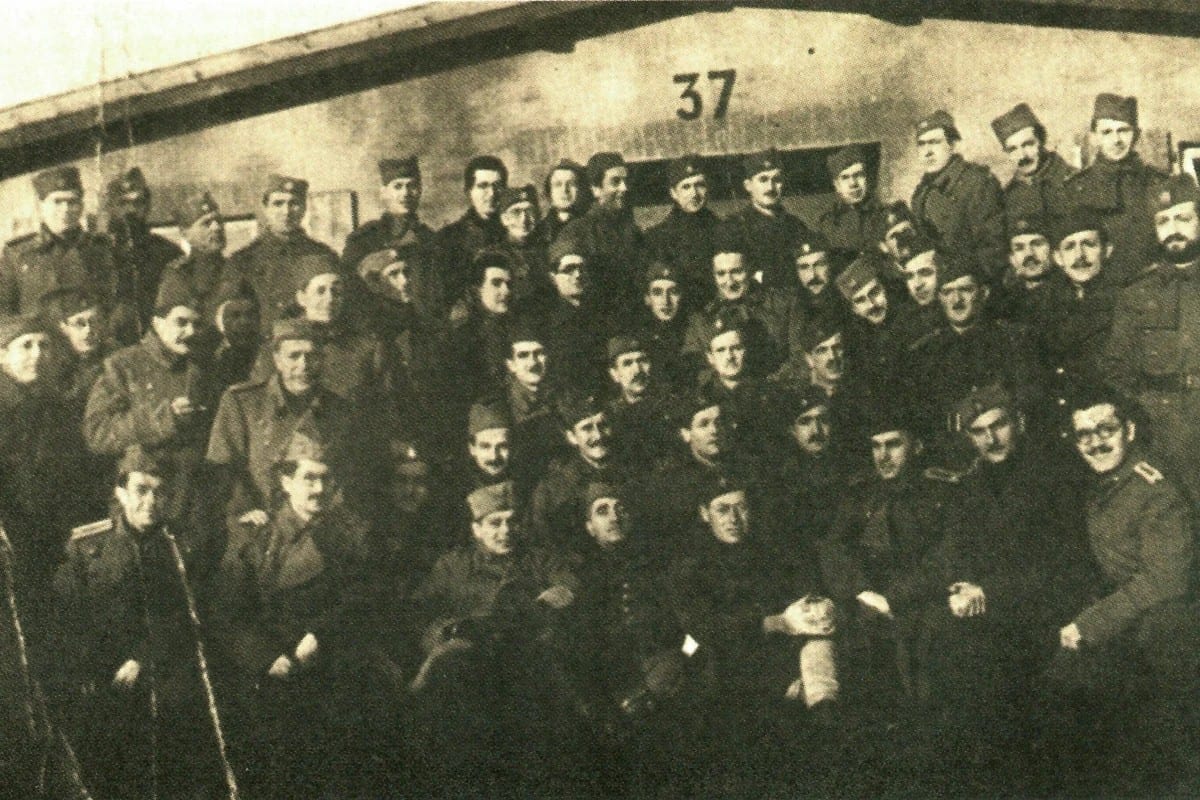
"History First Had to Be Kissed Awake" — the taz on Dr. Željko Dragić's Research into the Nazi Era in Osnabrück
The German daily taz (die tageszeitung) published an interview with historian Dr. Željko Dragić, who searches worldwide for descendants of the prisoners of the Osnabrück POW camp Oflag VI C. Since 2016 he has documented 500 prisoner-of-war letters and found 56 contemporary witnesses — and today, many families open their doors to him.
On 7 July 2026 the German daily taz (die tageszeitung) published an interview by Harff-Peter Schönherr with historian Dr. Željko Dragić under the headline "History first had to be kissed awake". The historian searches worldwide for descendants of the prisoners of the Osnabrück POW camp — today, many open their doors to him. We quote from the interview (translated from German): taz: Mr. Dragić, you research the Osnabrück Nazi prisoner-of-war camp Oflag VI C, and for that you search for descendants of the prisoners. How much is time working against you? Dragić: Very fast. I have been working on Oflag VI C since 2016 — before that, not much was known about it. One problem: even the second and third generations of descendants often no longer know that their grandfathers or great-grandfathers were in this camp. taz: What kind of camp was it? Dragić: It was built in the early 1930s for German opponents of the Nazi regime. Later, French and Dutch prisoners of war were held here, and from mid-1941 officers of the Kingdom of Yugoslavia — 6,500 in total, the majority Serbs, but also Slovenes, Czechs, Croats. 649 of them were Jews, and under the Geneva Convention they were allowed to practise their faith here — in a country that considered itself free of Jews.
taz: Two barracks of the camp still exist. Barrack 35, a Wehrmacht guard building, has housed an exhibition on the camp's history since 2021, which you curated. Here too you fight against forgetting. Dragić: Exactly. At the moment, however, the focus is on the search for contemporary witnesses. Most of the 56 I have found so far come from Serbia, the USA, Israel and Canada. Only six live in Germany. The task now is to search here specifically. taz: Are there still survivors of the camp? Dragić: The last one I know of died about 15 years ago. taz: With the loss of history told by survivors, preserving the authenticity of historical places has become doubly important. Does Barrack 35 have a future? Dragić: That depends on what the city of Osnabrück makes of it. Part of it could serve as a museum, the rest as a meeting place. But the renovation costs alone are estimated at over one million euros. At least it is a listed monument.
taz: In your search for descendants of former prisoners of war you are travelling to the USA at the end of July — to Chicago, and also to Milwaukee. How does that work? Dragić: Much of it is surprising, it is word of mouth. Often one door opens the next. The beginning was truly hard. When I was in the USA for the first time in 2019, I came back empty-handed. Nobody could or wanted to help me, because nobody knew who I was. Then the Serbian Orthodox Church supported me, and the Israeli embassy in Belgrade. History first had to be kissed awake. Today many people open their doors to me, and what they tell me is truly moving. I am not a melancholic, but I often have tears in my eyes. taz: There must be a lot of trust-building involved? Dragić: Of course. But many people are grateful and happy that they can talk to someone about this subject, which was silenced in their families for so long. Many prisoners wanted to forget that time; they did not want to pass on the suffering they had experienced to their children. Today there is a great deal of openness. When I am in the USA, I do not stay in a hotel — I stay with families whose ancestors lived through the camp.
taz: How did all this begin? Dragić: With eBay classified ads, in 2017. That is where I bought the first piece of prisoner-of-war mail. At the time I was not aware how much of this mail still exists. By now I have documented 500 letters. taz: What is the goal of this archive? Dragić: It shows how intertwined the nationalities are with one another — that Europe is a place of mutual understanding. Many mixed marriages testify to this, including those with German mothers and Serbian fathers. taz: Give us an example? Dragić: There is Branislav Popadić. I have already visited his son Mirko twice. Popadić was a Serb. In April 1941 he witnessed the destruction of Belgrade by the German air force. In Osnabrück he spent four years in captivity, under harsh conditions. In 1949 he met his future wife Lieselotte in Hamburg; later the family emigrated to the USA. His story is a reminder of courage, resilience, and the hope of building a new future even in the darkest of times. taz: Who finances your work? Dragić: I do this voluntarily. What I receive from these families is priceless. taz: How do you pass on your findings? Dragić: Through brochures, books, social media. At the moment we are planning a website that will present every life story, with all the documents.
Source: taz (die tageszeitung), "Forscher über NS-Zeit in Osnabrück: 'Die Geschichte musste erst wachgeküsst werden'", interview by Harff-Peter Schönherr, 7 July 2026. Read the original (in German) at: https://taz.de/Forscher-ueber-NS-Zeit-in-Osnabrueck/!6193748/
#Oflag VI C #Barrack 35 #press #research